Why World History Works Better One Period at a Time
I teach career-focused credit recovery, and if there's one thing I've learned over a decade in the classroom, it's that I can't count on a student being in my room two days in a row. Attendance swings. Schedules change. A kid who nailed yesterday's lesson might not show up again for a week. So somewhere along the way, I stopped building multi-day arcs for World History and started building every lesson to stand completely on its own.
The Problem With Multi-Day Arcs
A three-day unit on the causes of a war sounds great on paper. Day one is background, day two is the details, day three ties it together. That only works if the same students are in the room for all three days, and in my classroom, they're not. Miss day two and a student is lost for day three. I used to spend the first ten minutes of every class re-teaching what we covered last time instead of moving forward.
What a Stand-Alone Lesson Actually Looks Like
I build every World History toolkit around one question a student can answer by the end of a single period: why did this event happen, and what changed because of it. That means:
- A reading or slide deck that gives full context up front, not "as we discussed yesterday"
- One clear activity that gets finished in the same period it starts
- A quiz and exit ticket that check understanding of that day's content only, not a cumulative arc
- An answer key so I'm not the bottleneck if a substitute is covering my class
A lesson on the Cuban Missile Crisis works whether it's the first thing a student has seen from me all semester or the fortieth. Same with the Berlin Wall. Each one is a complete story: here's what happened, here's why it mattered, here's what a student can show me they understand by the end of the period.
Why This Matters More in Credit Recovery
My students are behind for a reason, and that reason is usually attendance, not ability. A student who's missed a third of the semester doesn't need me to lecture about what he missed. He needs a lesson he can walk into cold and still leave understanding. Stand-alone lessons don't just help my most consistent students. They're the only format that works for my least consistent ones, and in a credit recovery classroom, that's most of them.
It Also Makes Substitute Days Painless
I used to dread being out. A substitute covering a multi-day arc either skips the day entirely or tries to teach content they don't understand well enough to answer questions about. A stand-alone lesson with a slide deck, guided notes, and an answer key doesn't need me in the room to work. The sub reads the instructions, hands out the packet, and the lesson runs itself.
How I Build Every Lesson Now
Every toolkit in my World History library follows the same shape: one topic, one class period, everything a student needs to get through it without me standing over their shoulder. I'm not trying to replace a full-year survey course. I'm trying to make sure that whichever day a student shows up, that day's lesson actually lands for them.
If you're teaching a population where attendance is unpredictable, whether that's credit recovery, an alternative program, or just a rough flu season, I'd rather hand you forty lessons that each work alone than four units that only work if nothing goes wrong. Multi-day arcs are how history is often written. They're not how it has to be taught.
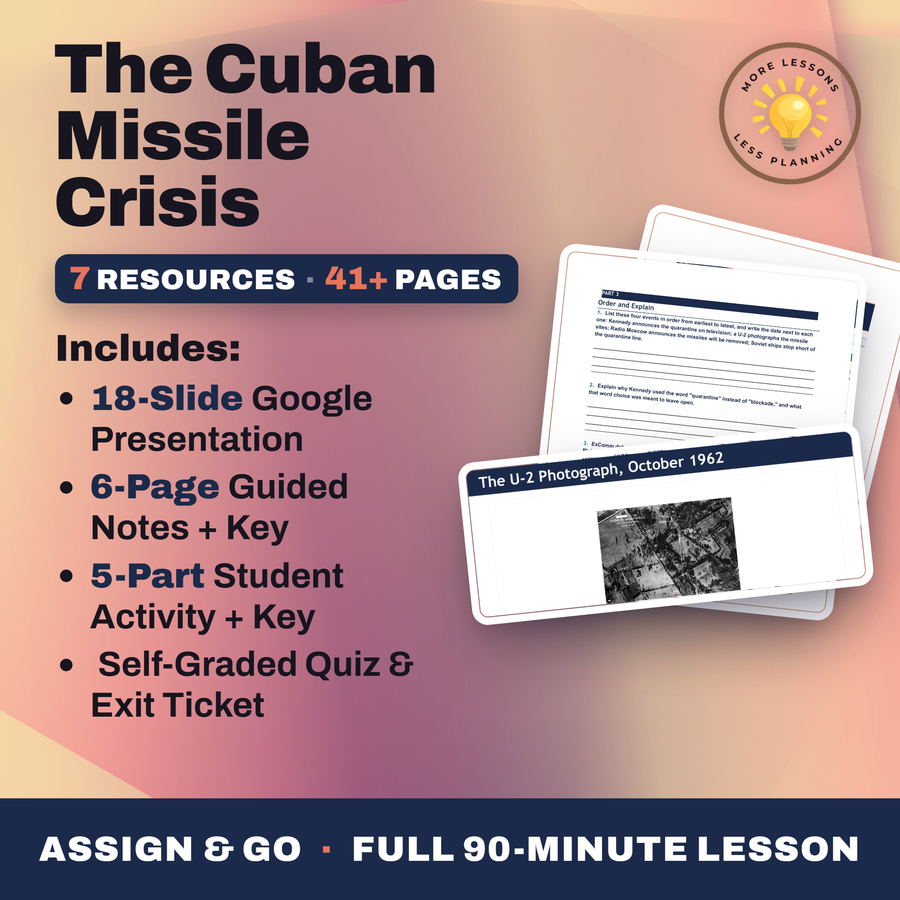
The Cuban Missile Crisis
Everything referenced in this post, in one download.
See it ($8.99)